Key hidden in Melmoth’s wool
Three Bags FullThe Key hidden in Melmoth’s wool is a small, round key concealed in the fleece of Melmoth, a sheep once chosen by George as the wildest of the flock. Its importance lies not only in what it may open: passed between human hands and hidden against a sheep’s body, it ties a practical mystery to an older bond between George and Melmoth. The key also becomes a test of observation, as Sir Ritchfield distinguishes it from another key by remembering its shape.
Discovery and Distinction
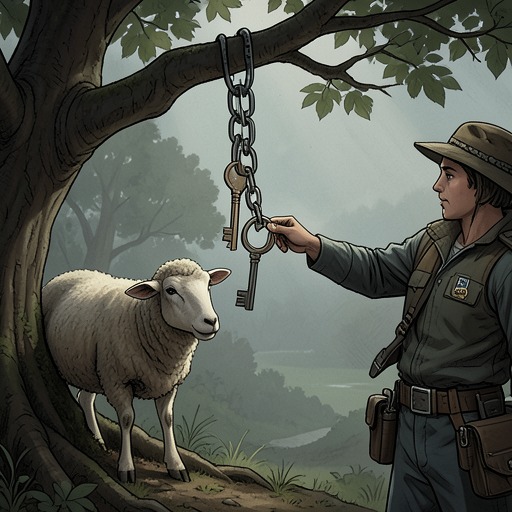
When Gabriel climbs a tree to peer into birds’ nests, the sheep watch because Miss Maple insists they keep him under close observation. They grow bored and even dizzy from looking upward, but Sir Ritchfield notices what matters: Gabriel has found a key in a nest. Zora, Miss Maple, and Othello see the key too; Ritchfield alone recognizes that it is not the one Josh brought the previous day with a packet of oatcakes.
Ritchfield identifies the difference by shape. The nest key is small and round, whereas the earlier key was long and thin. The distinction impresses the flock because Ritchfield has been prone to forgetting, yet he is so pleased with his observation that he does not realize he has also remembered yesterday’s object. The narration associates this improvement with Melmoth’s presence, suggesting that the key’s discovery does more than furnish a clue: it gives Ritchfield a concrete detail against which he can recover and demonstrate a memory.
Gabriel climbs down in high good humor and returns to the Shepherd’s caravan, where he puts the key in the lock. His reaction changes to an angry whistle. The reason for the whistle is not explained, and the scene does not establish exactly what happens at the lock; the flock can only observe the response. Gabriel’s sheep fall into silent panic, while George’s sheep watch them uneasily. Once Gabriel has marched back toward the village, their attention shifts to Melmoth, who stands beside the dolmen chuckling. The juxtaposition leaves the key’s significance unresolved while linking its appearance to Melmoth’s knowing amusement.
The Key in Melmoth’s Fleece
A later encounter makes the key’s intimate connection to Melmoth explicit. George approaches him with a knife and searches the wool beside his throat. Melmoth stands perfectly still as George finds a narrow thread buried deep in the fleece and cuts it. The key drops onto the ground, smooth and shining; George bends to pick it up and sighs. Concealment here is literal and bodily: the key has not simply been misplaced among the flock but fastened beneath Melmoth’s wool, where finding it requires George to know where to look.
Melmoth remembers the day George tied the key around his neck. George had chosen him, not Ritchfield, despite Ritchfield’s proudly raised horns, because Melmoth was the wildest of the bunch. Melmoth remembers the occasion as a great day for him. The recovered key therefore carries a history of recognition: it once marked George’s choice of Melmoth and the sheep’s sense of being specially valued.
George’s recovery of it ends in separation rather than reunion. He walks away without turning back. Ham protests that, after spending the day searching for Melmoth, George is now leaving him to run off and join another flock. Ham treats a sheep without a flock as helpless, insisting that such a creature will never make it. The key’s removal thus accompanies a rupture: what had been tied around Melmoth’s neck as part of a remembered bond is cut free, while George leaves Melmoth behind.
A Clue to the Safe
The key’s possible practical purpose emerges in a later exchange involving Gabriel and Eddie. Gabriel produces a shiny metal object from his pocket, and Eddie whistles through his teeth. Gabriel, who has not previously seemed tense to the sheep, now looks so for the first time. When Eddie identifies the object as a key to a safe, Gabriel asks how large such a safe might be. Eddie explains that it could be expensive and sophisticated, might also require a combination or several keys, and could vary greatly in size. A large safe would be difficult to carry away; a small one could not be blown open without destroying its contents.
That conversation raises the stakes around a key without fully settling its identity or history. The supplied scenes do not explicitly establish that the object Gabriel shows Eddie is the same key George cut from Melmoth’s fleece, nor do they reveal what the safe contains. They do, however, place a key associated with Melmoth’s concealed wool beside Gabriel’s interest in safe access. The distinction matters: the fleece scene supplies a personal history and a physical recovery, while Eddie’s explanation supplies a possible kind of lock and a reason that a key might matter to Gabriel.
Significance
The key moves between states of concealment and recognition. Hidden in Melmoth’s fleece, it is invisible to ordinary inspection; once Gabriel finds a key in a nest, its small, round shape becomes an observable difference that Ritchfield can remember. Later, George’s knife and search make the concealed object visible again, and the cut thread turns an old attachment into something severed. These changes give the key a narrative role beyond its possible use in a lock: it carries traces of who concealed it, who could recognize it, and who once tied it to Melmoth.
The object also draws attention to the flock’s limited but precise knowledge. The sheep see Gabriel find and use a key, register the panic among his sheep, and notice Melmoth chuckling, but they cannot immediately explain the relations among those details. Eddie’s account of safe keys offers a concrete possibility, not a complete solution. The key remains a material clue whose shape and placement are known more clearly than its full purpose; its significance grows through the contrasts between what the sheep observe and what they can infer.